Death waits / Person arrives
Person enters what he thinks is his house and finds Death already seated there. The scene must feel less like an attack and more like an appointment Person did not know he had kept.
A visual explainer for editorial assembly and production reference. This page follows the current screenplay order, not the day’s shooting order, so post can line footage up against the actual story without re-solving the chronology every time.
Use this when dailies arrive out of order, when the storyboard boards and the script feel like they’re talking past each other, or when the last three Lady scenes appear unnumbered in the script packet. For editorial clarity, this page treats those final beats as SC11 / SC12 / SC13.
This explainer consolidates the current screenplay, the shooting plan, and the storyboard boards into one editorial view. It is built for cutting, not just scheduling.
10 numbered screenplay scenes plus 3 connective Lady beats.
Production grouped by logistics; the cut should not mirror that order.
Summoning, Debate, Gamble/Kill, Lady/Confession/Final bench.
The film lives on whether that line feels like a choice rather than an effect.
| Story scene | Script beat | Shoot block | Visual board | Must survive the cut |
|---|---|---|---|---|
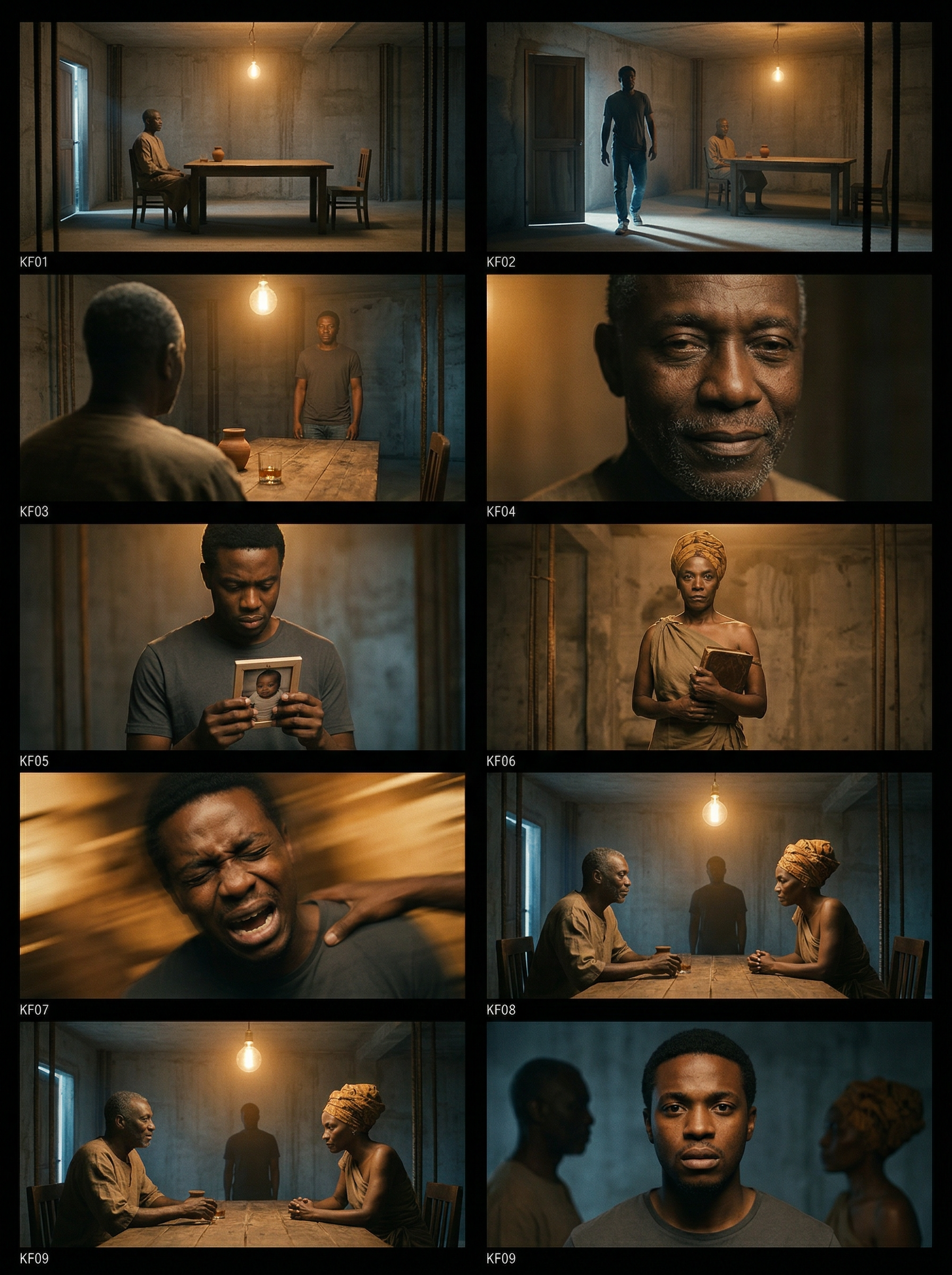
| SC1 | Death waits / Person arrives | Block 1 | Grid 1 | Death is calm, not villainous; Person’s unfinished life is triggered by the baby photo. |
| SC2 | Life reveals + flashback rupture | Block 1 | Grid 1 | Life changes the room’s power immediately, and Person is left genuinely traumatised. |
| SC3 | Twin standoff | Block 2 | Grid 2 | They are siblings; Death is early and unashamed; Person is caught between them. |
| SC4 | Book of Life / unfinished business | Block 2 | Grid 2 | Person still has pages left; at least three unfinished tasks need to land. |
| SC5 | Death’s seduction | Block 2 | Grid 2 | Death offers real peace, not a trick. Person should be visibly tempted. |
| SC6 | “Not yet” / Death exits | Block 2 | Grid 2 | The second “Not yet” must feel chosen; hold the release after Death leaves. |
| SC7 | Coffin scene | Block 5 | Grid 3 | The Woman’s goodness is real, Life is desperate, and Death answers with sadness rather than force. |
| SC8 | Game is set | Block 3 | Grid 3 | Rules are crystal clear before the die starts rolling. |
| SC9 | Rolling / Death wins | Block 3 | Grid 3 | The game escalates; Death cracks open and then hits one. |
| SC10 | Wrong body / first kill | Block 3 | Grid 3 | Life kills the wrong person, Death names it, and the bloody-hands aftermath lands. |
| SC11 | Park A — Death watches the Lady | Block 6A | Grid 4 | Death’s closeness ages her; this is the first time he fears himself. |
| SC12 | Interior confession | Block 4 | Grid 4 | “I love her” needs space. The scene reveals that Death wants to stay, not collect. |
| SC13 | Final bench / final question | Block 6B | Grid 4 | The Lady’s question lands unanswered. End on held silence, not plot cleanup. |
SC7 was shot later than SC8–10 because the coffin is a location move. In the finished film it belongs before the dice game.
SC12 was shot as an indoor reset block, but it belongs after Park A. Editorially it is the emotional bridge between fear and the final bench scene.
The screenplay labels the last three beats as unnumbered scenes. For post, keep them logged as SC11 Park A, SC12 Confession, SC13 Park B.

Room introduction, Person enters, Death speaks first, then Life tears open the scene. This board establishes the chamber-play grammar and the amber / cold split of the room.

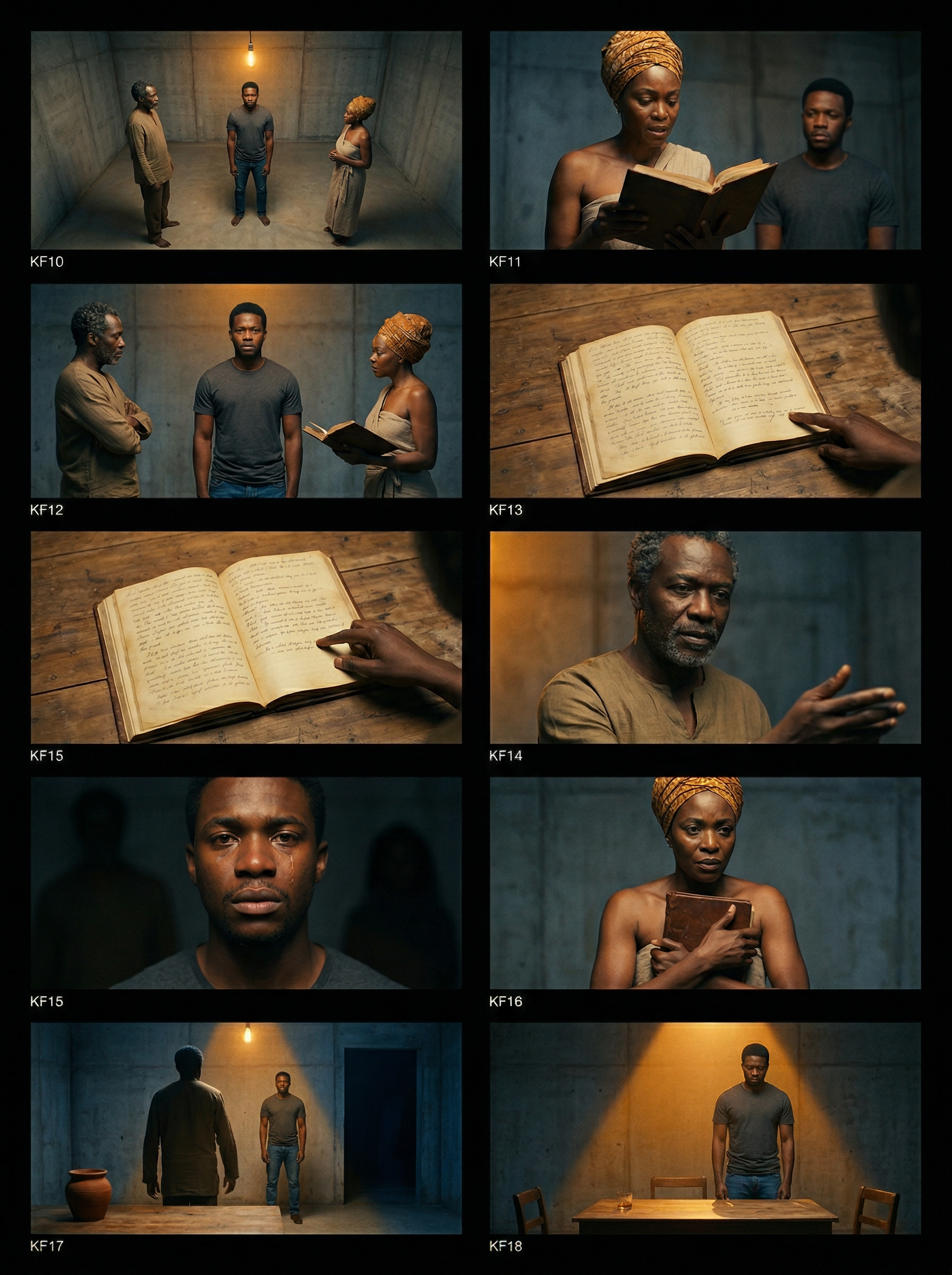
All four debate scenes belong to one pressure chamber. The cut should move from ping-pong argument to intimate temptation to a fragile release.

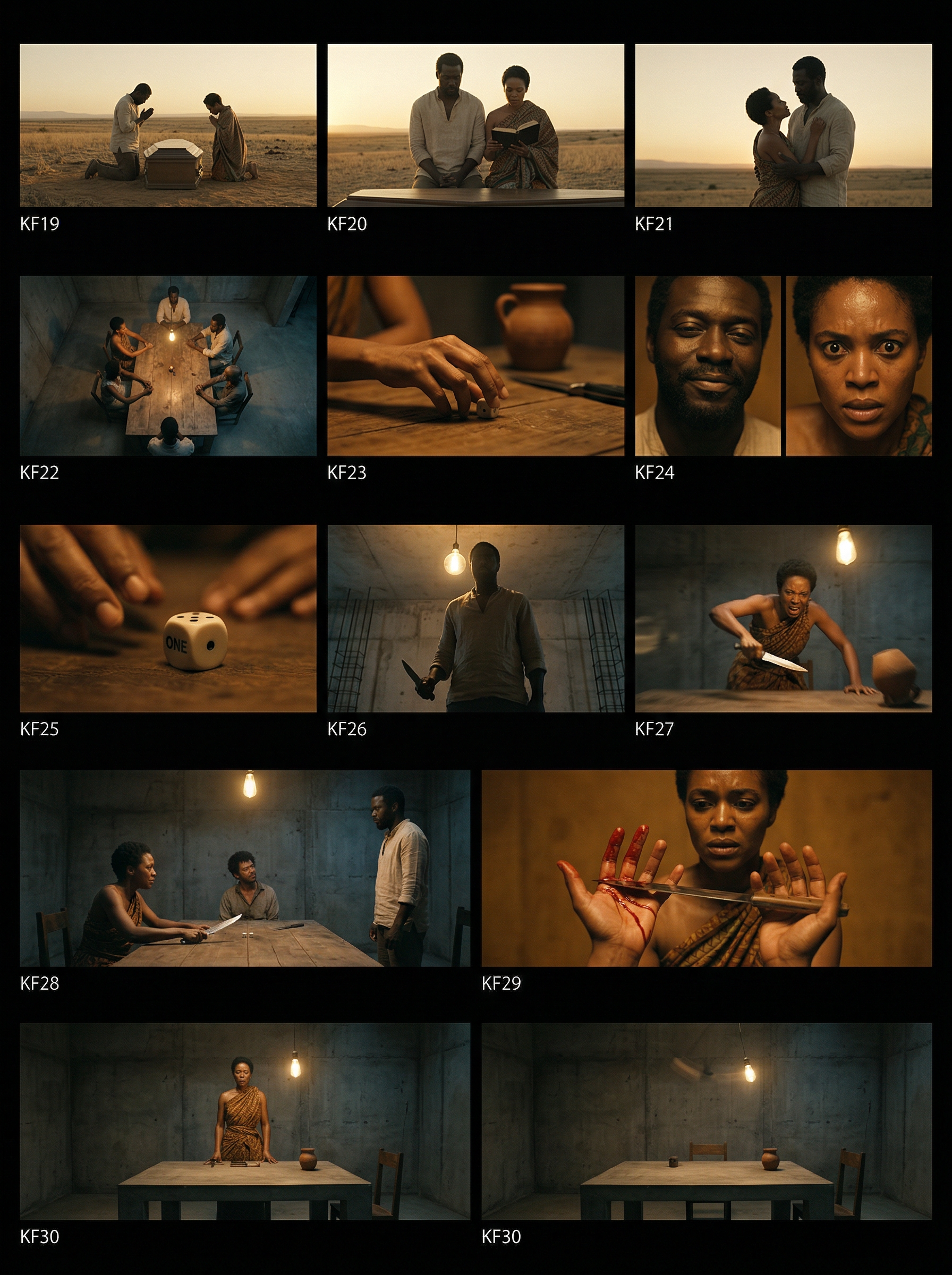
This board spans two very different movements: the outdoor coffin tenderness and the table-game tragedy. Editorially treat them as separate sequences even though they share one board set.

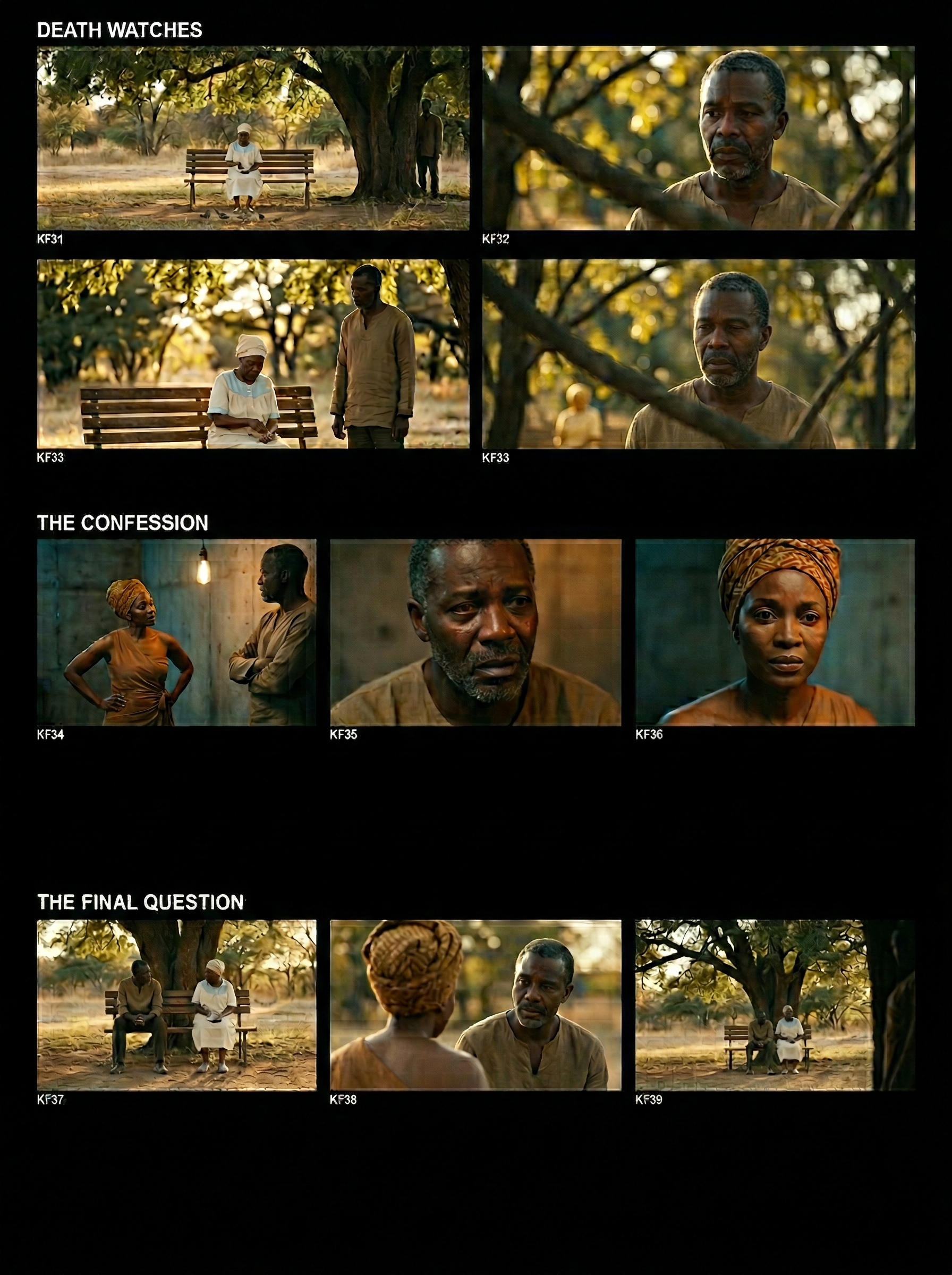
The last board contains Park A, the interior confession, and Park B. This is the emotional key to the whole film: Death becomes vulnerable, then speechless.
SC1–2. The chamber-play grammar is set here: one room, one man, two immortals, and a premise delivered with unnerving calm.
Person enters what he thinks is his house and finds Death already seated there. The scene must feel less like an attack and more like an appointment Person did not know he had kept.
Life enters like a pressure shift, not a jump scare. The scene pivots from metaphysical argument to traumatic interruption when Death pushes Person into flashback and the room briefly breaks open.
SC3–6. One escalating chamber sequence: sibling argument → unfinished business → seduction → the chosen refusal of death.
Death and Life stop speaking through Person and address each other directly. The scene exists to reveal familiarity: these are not abstract forces meeting for the first time, but siblings resuming an eternal argument.
Life reads Person’s unfinished moral work aloud. The scene is exposition, but it must play like evidence in a trial: this soul still has pages, still has tasks, still has work in the world.
Death stops winning with logic and starts winning with relief. Editorially this scene only works if the offer sounds genuinely desirable — a real release from pressure, grief, memory, and failure.
Person refuses Death not with triumph but with honesty. Death respects the refusal, Life hands Person his remaining pages, and the room finally exhales.
SC7–10. The film moves outward, then tightens again into ritual. This is where Life’s desperation becomes action — and then tragedy.
Death kneels beside a woman’s coffin while Life reads the record of her goodness. The scene has to widen the film’s moral world beyond Person and show Life losing faith in Death’s restraint.
Life formalizes the conflict into chance. The audience must understand the exact rule before suspense can start: first to roll one decides the soul’s fate.
Between turns, Life reaches back toward the brother Death used to be. The scene’s suspense comes from the die, but its dramatic value comes from Death admitting that he changed because he saw too much.
Life lunges to protect a soul and kills that soul instead. This scene is the film’s turn. The cut should privilege readable action, emotional irony, and aftermath over speed for its own sake.
SC11–13. Death is no longer just the collector. He becomes someone capable of attachment — and therefore incapable of acting cleanly.
The Lady hums, feeds birds, and unknowingly rehumanizes Death through memory. His approach begins to age her, turning attraction into horror.
Life corners Death and forces the truth into speech: he loves the Lady. The film’s mythology bends here; Death stops being principle and becomes person.
Life urges Death to collect. Instead he sits beside the Lady, listens, and fails to act. She unknowingly asks the final question directly to Death himself. He cannot answer.
Room world: table centre, three chairs, Edison bulb, haze, whiskey, clay pot. Keep the room’s iconography consistent whenever possible.Baby photo belongs to the early reckoning. If it appears, we are still in Person’s unfinished-life corridor.Book of Life should recur as a real object, not just spoken concept: SC2, SC4, SC7.Game world: die, knife, soul catcher, and blood belong to one escalating ritual chain in SC8–10.Park world: bench, crumbs, humming, gentle light, and aging progression are the emotional texture of the ending.Quiet premise → argumentative acceleration → seductive stillness → reprieve → widened moral world → ritual suspense → tragedy → confession → silence.
Favor performance clarity over perfect prop continuity. This film is a chamber piece first and a coverage puzzle second.
When in doubt, hold longer on the final bench. The ending is not the line itself — it is Death’s inability to answer it.